
Cellulose and fiberglass loose fill
Blown-In Insulation in Brainerd, MN
A deep, even layer on top of a sealed attic floor, or dense-pack in closed walls, costing less than foam across big areas.
- Free on-site estimates
- Written quote listing R-value and depth area by area
- Air leaks and moisture checked before anything is covered
Deep Fill for Big Attic Floors
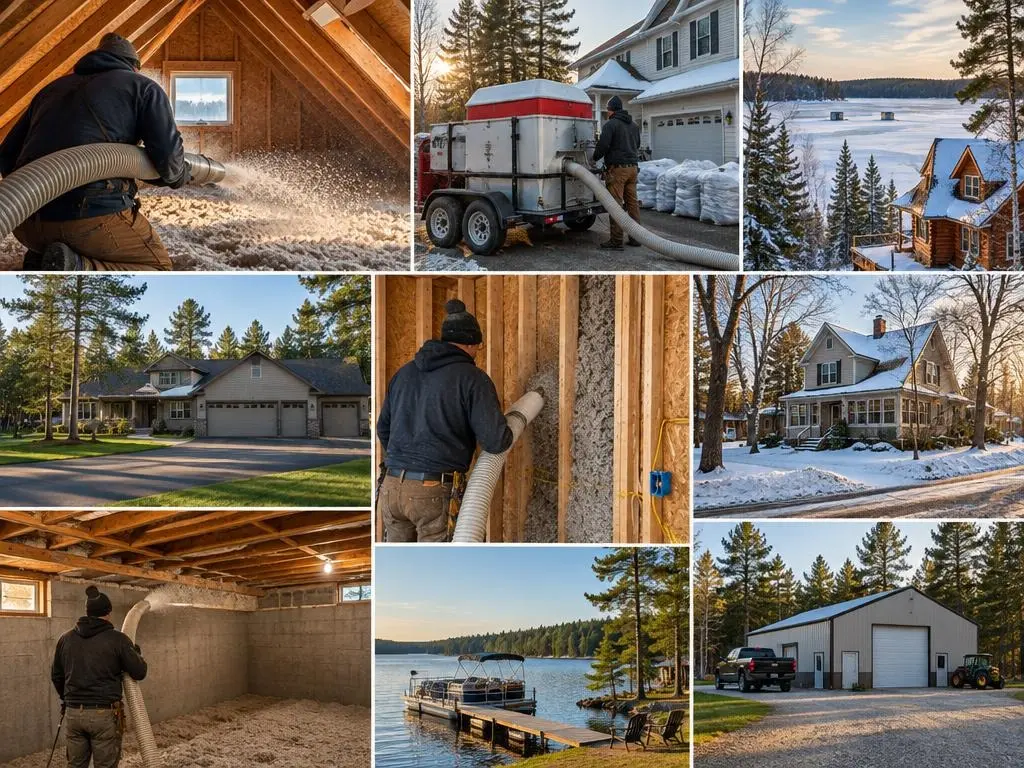
Blown-in insulation in Brainerd is often the right material for the largest surface in the house: the open attic floor. Loose-fill cellulose or fiberglass is blown through a hose into an even layer that wraps around joists, wiring and awkward framing more completely than batts can. It costs less per square foot than spray foam, and over a properly sealed ceiling it delivers the depth a Zone 7 attic needs. Most of our attic jobs pair the two: foam and caulk to seal the leaks, then blown-in on top.
Getting to the right depth
The efficientwindows.org summary of Minnesota's energy code lists R-49 for ceilings in Climate Zone 7, which includes Crow Wing County. For an attic with no insulation in that zone, the Department of Energy aims for R-60; over 3 to 4 inches of existing insulation, it suggests adding R-49. HomeGuide lists blown fiberglass at R-2.2 to R-2.9 per inch and cellulose at R-3.1 to R-3.8 per inch. That means a deep layer, often well over a foot. We set depth markers across the attic so you can see what you paid for, and the target R-value and depth go on the quote.
Cellulose or fiberglass
Cellulose starts as recycled newsprint and paper, with additives against fire and pests. Compared with loose fiberglass it is denser, packs more R-value into each inch and does a bit more to slow air moving through the layer. Fiberglass weighs less, settles less and does not take up water the way cellulose can. Both work. In very cold attics, loose fiberglass can lose some performance as air moves through it, which is one reason sealing the floor first matters. We explain the trade-offs and price the one that fits your attic, or both if you want to compare.
Seal first, always
Blown-in insulation slows heat, but air passes through it. If warm air leaks up around plumbing stacks, light boxes, chimney chases and top plates, it carries heat and moisture straight through a new layer of fill and into the attic. In Brainerd, where Minnesota Rule 1303.1700 puts the ground snow load at 60 psf and roofs hold snow for months, that leaking heat is what melts snow into ice dams. So before we blow anything, we seal the bypasses, cover and seal the hatch, and fit baffles at the soffits to keep the vents open once the new fill goes in.
Walls in older homes
Many houses from Brainerd's early decades have exterior walls with little or no insulation. Dense-pack cellulose can be blown into closed wall cavities through small holes drilled from outside or inside, then plugged and patched. It fills the cavity tightly enough to slow air through the wall too. Before we drill, we check for old knob-and-tube wiring, fire blocking and the layout of the cavities, because those change the plan. HomeGuide lists blown-in exterior walls at $1.10 to $3.70 per square foot.
Topping up an old attic
If your attic has a few inches of old fill that has settled, adding more on top is often the cheapest improvement you can make. We confirm the existing fill is clean and dry, pull it back where we need to seal underneath, and blow new fill over the top. If the old insulation is wet, moldy, full of rodent waste or looks like vermiculite, it comes out first; that is covered on our insulation removal page.
Cabins and low attics
Some lake cabins have shallow attics with low clearance, limited access or no attic floor at all. We look at whether there is room for the depth you need, whether the eaves can be kept vented, and whether a section is better handled with foam. Where a full-depth layer will not fit, we say so and explain the option. We also look at how the cabin will be used. A place kept heated all winter needs the full target depth, while one shut down from October to May may get most of its benefit from sealing and a moderate layer, with the water lines drained or protected separately.
Access matters too. Blown-in goes through a hose run from a truck or machine outside, usually through the attic hatch or a gable vent. If the hatch is in a closet or the attic has low spots near the eaves, we plan the route and the order of work so the hose reaches every bay without walking on the drywall below. A well-blown attic looks flat and even from wall to wall, with no thin spots at the edges where the cold gets in. That evenness is what you are paying for.
We blow insulation after the air sealing is done, mark the depth, and clean up before we go. Ask us to look at your attic and we will give you a written quote with the depth and R-value. Get a free estimate
Blown-In Work We Do
Loose-fill jobs in Brainerd area homes and cabins.
Blown cellulose attics
Treated recycled-paper fill at R-3.1 to R-3.8 per inch (HomeGuide) over a sealed attic floor.
Blown fiberglass attics
Lighter loose fill at R-2.2 to R-2.9 per inch (HomeGuide) for attics where settling or moisture is a concern.
Top-ups over old fill
New fill blown over dry, clean existing insulation to reach the target depth.
Dense-pack walls
Cellulose blown tightly into closed exterior wall cavities in older homes.
Baffles and depth markers
Vent chutes at the eaves and markers so you can see the finished depth.
Published Blown-In Insulation Costs
| Job | Range and source |
|---|---|
| Blown-in, per sq ft | $1.00 to $2.80 (HomeGuide); $1.65 to $3.80 (Fixr) |
| Attic | $900 to $3,600 (HomeGuide); $1,750 to $5,500 for about 1,500 sq ft (Fixr) |
| Exterior walls | $1,900 to $7,800, $1.10 to $3.70 per sq ft (HomeGuide); $2,000 to $4,000 (Fixr) |
| Dense-pack cellulose | $1.60 to $4.20 per sq ft (HomeGuide) |
| Fiberglass / cellulose | $1.65 to $2.60 / $1.75 to $3.80 per sq ft (Fixr) |
| Typical job | $800 to $3,000 (HomeGuide); $3,000 to $7,000 (Fixr) |
National ranges from HomeGuide (Nov 2025) and Fixr (Aug 2025). Depth, attic access, air sealing and any removal change the total. The written estimate we give you after the visit is the price.
How a Blown-In Job Works
1. Inspect the attic
Measure existing depth, check condition and moisture, find the leaks and check the vents.
2. Quote
Air sealing, baffles and blown-in priced as separate lines with target depth and R-value.
3. Seal and prep
Seal bypasses, install baffles, weatherstrip the hatch and set depth markers.
4. Blow to depth
Fill blown evenly to the marked depth across the attic.
5. Clean up
Clean the path through the house and show you the finished attic.
Why Choose Us for Blown-In Insulation
Depth markers left behind
You can check the depth any time after we leave.
Sealed before it is covered
Bypasses get closed first so the fill is not working against leaks.
Material choice explained
Cellulose or fiberglass, with the reason on the quote.
Blown-In Insulation Questions
Is blown-in insulation as good as spray foam?
For an open attic floor over a sealed ceiling, blown-in reaches the target R-value for less money. Foam wins on rim joists, rooflines and tight spots where keeping out air and moisture counts the most.
Cellulose or fiberglass for a Minnesota attic?
Both work. Cellulose packs more R-value per inch and slows air a bit better; fiberglass is lighter and settles less. We explain the trade-offs for your attic.
How deep should blown-in be in Brainerd?
With fiberglass at R-2.2 to R-2.9 per inch and cellulose at R-3.1 to R-3.8 (HomeGuide), reaching R-49 to R-60 means a layer well over a foot deep. The quote lists the depth.
Can you blow insulation into my existing walls?
Often yes, with dense-pack cellulose through small holes that are plugged afterward. We check for old wiring and blocking first.
Blown-In Insulation Service Areas
- Spray Foam Insulation in Brainerd, MN
- Spray Foam Insulation in Baxter, MN
- Spray Foam Insulation in Nisswa, MN
- Spray Foam Insulation in Pequot Lakes, MN
- Spray Foam Insulation in Crosslake, MN
- Spray Foam Insulation in Breezy Point, MN
- Spray Foam Insulation in Crosby, MN
- Spray Foam Insulation in Ironton, MN
- Spray Foam Insulation in Deerwood, MN
- Spray Foam Insulation in Emily, MN
- Spray Foam Insulation in Pine River, MN
- Spray Foam Insulation in Hackensack, MN
- Spray Foam Insulation in Walker, MN
- Spray Foam Insulation in Little Falls, MN
- Spray Foam Insulation in Pillager, MN
- Spray Foam Insulation in Motley, MN
- Spray Foam Insulation in Staples, MN
- Spray Foam Insulation in Garrison, MN
- Spray Foam Insulation in Aitkin, MN
- Spray Foam Insulation in Lake Shore, MN
- Spray Foam Insulation in East Gull Lake, MN
- Spray Foam Insulation in Fifty Lakes, MN
Get a Blown-In Insulation Estimate
Ask us to measure your attic. You will get a written quote with depth, R-value and price.