
Rim joists, foundation walls, crawl spaces
Basement & Rim Joist Insulation in Brainerd, MN
Seal the band joist and insulate the concrete so the basement stays warmer and dry, and the floors above stop feeling cold.
- Free on-site estimates
- Written quote listing R-value and depth area by area
- Air leaks and moisture checked before anything is covered
Five Feet of Frost, One Thin Band of Wood
Basement and rim joist insulation in Brainerd starts at the band of wood that sits on top of the foundation wall. That rim joist runs around the whole house, it is usually just an inch and a half of lumber, and in many homes it has a loose piece of fiberglass stuffed against it or nothing at all. Cold air leaks in at the sill plate and through the joint, and the basement feels it. Minnesota Rule 1303.1600 places Crow Wing County in frost Zone I, where footings must sit at least five feet deep, so the ground around a Brainerd foundation freezes hard every winter.
Why closed-cell foam on the rim
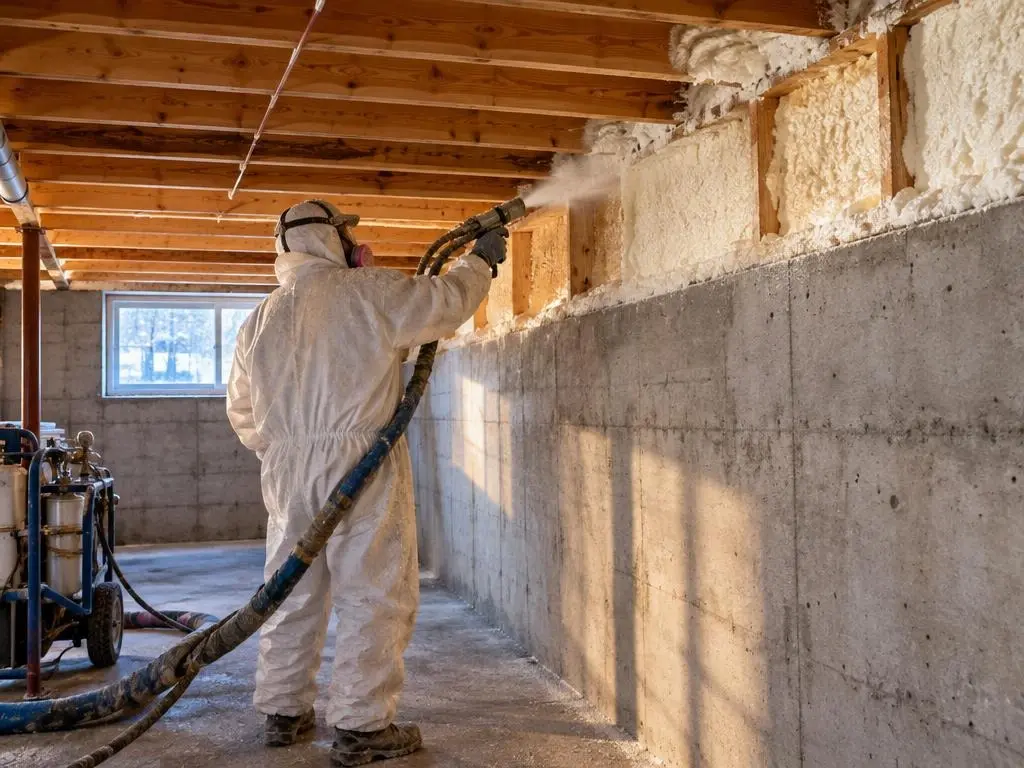
Fiberglass batts against a rim joist do not stop air, and warm, moist basement air that reaches the cold wood behind them can condense there. Over time that means damp, moldy batts and rot at the sill. Closed-cell spray foam sprayed directly on the rim and sill seals the air gaps and insulates in one layer, and because HomeGuide lists it at R-5 to R-7 per inch, a few inches go a long way. It also slows vapor, so indoor moisture does not reach the cold wood. Rim joists are one of the jobs where foam is almost always the right material.
Foundation walls
Poured concrete and block walls are cold and slightly damp in a central Minnesota basement. Warm indoor air that touches them can condense, which is why so many basement walls smell musty behind old paneling. Closed-cell foam or rigid foam board sprayed or fastened directly to the concrete keeps the warm air off the cold surface. Fiberglass batts placed tight against concrete with a plastic sheet in front tend to trap moisture, and we often pull out exactly that kind of wall during remodels. We check the walls for active water before insulating; foam does not fix a leaking foundation, and drainage, grading or crack repair come first.
Before you finish the basement
The easiest time to insulate a basement is before the framing goes up. With the walls open, foam goes on the rim joists and concrete quickly, and you avoid tearing out new drywall later. Tell us your framing plan, where the outlets and plumbing will run, and whether you want the foam to cover the full wall height. We schedule the work so your framer can start right after. The efficientwindows.org summary of Minnesota's energy code lists Zone 7 wall targets for above-grade walls; basement walls have their own code values, so if you are pulling a permit, your city's building office can confirm what applies.
Crawl spaces under lake cabins and additions
Many cabins around the Brainerd lakes and many additions on older homes sit on crawl spaces instead of full basements. A vented crawl space with fiberglass between the floor joists is common, and in winter it often means cold floors and frozen pipes. There are two ways to fix it. One is to insulate the floor above the crawl space; DOE recommends R-38 for an uninsulated floor in Zone 7. The other is to close the vents, cover the ground with a sealed vapor barrier, and insulate the crawl space walls with closed-cell foam so the space stays near house temperature. The second approach usually protects plumbing better. We look at what is down there and explain which one fits.
Moisture and old houses
Brainerd's older homes from its railroad years often have stone or block foundations, damp corners and patched sill plates. Before we spray, we check moisture in the wood and on the walls, look for daylight at the sill, and point out anything that needs a carpenter first. If we find rotted sill or rim, we tell you rather than covering it.
Cantilevers and floors over garages
Cantilevered floors that hang out past the foundation, like bump-outs and bay windows, share the same problem as rim joists: a thin piece of framing open to the cold. So do floors over attached garages. Closed-cell foam fills and seals these from below, and it helps keep garage fumes out of the room above.
One more thing we watch for: the sill plate where the wood meets the concrete. On many older foundations there are gaps you can see light through, or old mortar that has crumbled away. Those gaps let in cold air and insects. We seal them as part of the rim joist work, and if a gap is large enough to need a carpenter or mason, we tell you before we spray rather than filling a structural problem with foam. A dry, sealed rim and wall make the basement easier to heat and much nicer to finish.
Ask us to look at the basement and the rim joist on the same visit as the attic. Sealing the bottom and top together is what stops the draft through the whole house. Get a free estimate
Below-Grade Work We Do
Common basement and crawl space insulation jobs in the Brainerd area.
Rim joist spray foam
Closed-cell sprayed on the band joist and sill plate around the whole basement.
Foundation wall insulation
Closed-cell foam or foam board directly on poured or block walls, ready for framing.
Crawl space walls and vapor barrier
Sealed ground cover and closed-cell on the walls for a conditioned crawl space.
Floors over crawl spaces
Insulating the floor framing from below where the crawl space stays vented and cold.
Cantilevers and bump-outs
Foam in floors that hang past the foundation and lose heat on three sides.
Floors over garages
Sealing and insulating the ceiling of an attached garage under a living space.
Published Basement & Rim Joist Insulation Costs
| Job | Range and source |
|---|---|
| Rim joists, spray foam | $2,000 to $2,500 (HomeGuide) |
| Closed-cell, installed | $3.00 to $5.00 per sq ft (HomeGuide) |
| Crawl space, spray foam | $2,000 to $4,000 (HomeGuide); $1,000 to $5,900 (Fixr) |
| Crawl space encapsulation | $3 to $10 per sq ft, $3,000 to $15,000 (HomeGuide) |
| Crawl space vapor barrier | $1,200 to $4,000 (HomeGuide) |
| Closed-cell on crawl space walls | $2 to $5 per sq ft (HomeGuide) |
| Crawl space vent sealing | $150 to $450 (HomeGuide) |
Sources: Fixr (2025), plus HomeGuide's 2026 guides to spray foam and to crawl space encapsulation. How many linear feet of rim, how tall the walls are, access and prep decide the total, and the written estimate we give you is the price.
From Visit to Finished Rim
1. Look and measure
Measure the rim and walls, check moisture, find air gaps and any rot.
2. Quote
Rim, walls and crawl space listed separately with foam type and thickness.
3. Prep
Pull old batts, clear the work area, cover the floor and mask mechanicals.
4. Spray
Closed-cell on the rim, sill and walls to the planned thickness.
5. Ventilate and clean up
Ventilate during cure, clean up and walk you through the result.
Why Choose Us for Basement & Rim Joist Insulation
Moisture checked first
Wet walls and rotted sills get pointed out before we spray.
Timed for your framer
We schedule around your basement finishing plan.
Rim and attic on one visit
One look at both ends of the house, one written quote.
Basement & Rim Joist Insulation Questions
Is spray foam on the rim joist worth it?
In a Brainerd basement, usually yes. The rim is a big air leak along the whole perimeter, and closed-cell seals and insulates it in one pass without trapping moisture behind a batt.
Should I foam the basement walls before or after framing?
Before. With bare walls the foam goes on fast and evenly, and you do not have to cut into new drywall later.
Are fiberglass batts enough for the rim joist?
Batts slow heat loss but let air through, and moist air can condense on the cold wood behind them. That is why many old rim batts are damp or moldy when we pull them out.
Should I seal my crawl space vents?
If you plan to condition the crawl space with a sealed vapor barrier and insulated walls, yes. If the floor above is insulated instead, the crawl space stays vented. We walk you through both for your house.
My basement takes on water every spring. Is insulating it still possible?
We fix nothing by covering water. Drainage, grading or crack repair should come first. Once the walls stay dry, closed-cell foam works well there.
Basement & Rim Joist Insulation Service Areas
- Spray Foam Insulation in Brainerd, MN
- Spray Foam Insulation in Baxter, MN
- Spray Foam Insulation in Nisswa, MN
- Spray Foam Insulation in Pequot Lakes, MN
- Spray Foam Insulation in Crosslake, MN
- Spray Foam Insulation in Breezy Point, MN
- Spray Foam Insulation in Crosby, MN
- Spray Foam Insulation in Ironton, MN
- Spray Foam Insulation in Deerwood, MN
- Spray Foam Insulation in Emily, MN
- Spray Foam Insulation in Pine River, MN
- Spray Foam Insulation in Hackensack, MN
- Spray Foam Insulation in Walker, MN
- Spray Foam Insulation in Little Falls, MN
- Spray Foam Insulation in Pillager, MN
- Spray Foam Insulation in Motley, MN
- Spray Foam Insulation in Staples, MN
- Spray Foam Insulation in Garrison, MN
- Spray Foam Insulation in Aitkin, MN
- Spray Foam Insulation in Lake Shore, MN
- Spray Foam Insulation in East Gull Lake, MN
- Spray Foam Insulation in Fifty Lakes, MN
Get a Basement & Rim Joist Insulation Estimate
Planning to finish the basement? Call before framing and we will price the rim and walls.