
Homes, lake cabins and shops in the Brainerd Lakes Area
Spray Foam Insulation in Brainerd, MN
Stop the drafts, frost and ice dams that a Crow Wing County winter finds: foam where it pays, blown-in where it does not, all priced in writing.
- Free on-site estimates
- Written quote listing R-value and depth area by area
- Air leaks and moisture checked before anything is covered
Insulation Built Around a Minus-54 Record
Spray foam insulation in Brainerd is about holding heat through a long, hard winter. The city's 1991-2020 climate table on Wikipedia lists a January daily mean of 8.8F, an average January low of -2.0F and a record low of -54F, and snowfall averaging about 48 inches per year. Any house leaking air at the attic and the rim joist pays for it daily from November to March. We seal those leaks and insulate the spaces that need it, using open-cell or closed-cell spray foam where it makes sense and blown-in insulation where that does the job for less.
The cold, in code terms
Minnesota's energy code county list places Crow Wing County in Climate Zone 7, the coldest band in the state, and the efficientwindows.org summary of that code lists R-49 for ceilings and R-20 plus R-5 continuous, or R-13 plus R-10, for wood-frame walls in that zone. For older homes the Department of Energy sets the bar higher: a Zone 7 attic with no insulation should reach R-60, and one that already holds 3 to 4 inches should get another R-49. Minnesota Rule 1303.1600 puts the county in frost Zone I with a five-foot minimum footing depth, and Rule 1303.1700 sets its ground snow load at 60 pounds per square foot. Deep frost and deep snow are the two forces that drive most of what we do: cold basements and rim joists at the bottom of the house, ice dams and attic frost at the top.
Where Brainerd houses lose heat
Brainerd was founded in 1870 where the Northern Pacific crossed the Mississippi, and its population peaked at 12,898 in 1960. The result is a city of mixed ages: pre-war two-stories, post-war story-and-a-halfs, ranches and newer infill. Each type leaks in its own places. Older framing often has open cavities that run from the basement to the attic. Story-and-a-half homes lose heat through kneewalls and the short attic floors behind them. Almost every house has an uninsulated or poorly sealed rim joist, the band of wood that sits on top of the foundation wall and lets cold air in along the whole perimeter. In the attic, warm air escapes around plumbing stacks, chimney chases, light boxes, bath fans and the hatch, and that warm air is what melts roof snow into ice at the eaves.
The 2020 census counted 6,473 housing units in Brainerd with only 6.0% vacant, so most homes here are heated all winter. That makes air sealing pay off quickly in comfort, and it is why we always look at the attic and the basement on the same visit.
Closed cell vs open cell, and when foam is not the answer
Open-cell foam is light and airy. It swells to fill a cavity and blocks air well, yet some water vapor still moves through it. HomeGuide lists it at R-3.5 to R-3.7 per inch. Closed-cell foam is dense and rigid, at R-5 to R-7 per inch, and at typical thickness it slows vapor and does not soak up water. In our climate that makes closed-cell the usual choice for rim joists, basement walls, crawl spaces, steel buildings and roof decks that lack space for vent channels. Open-cell can work well in interior walls, above-grade cavities and some roof assemblies where a vapor retarder is handled separately.
Foam is not the cheapest way to insulate a wide, open attic floor. On many Brainerd homes the better plan is to seal the attic bypasses with foam and caulk, then blow cellulose or fiberglass to depth over the top. We tell you which approach fits each part of the house, and if two would work, the quote shows both.
Lake cabins, seasonal homes and outbuildings
The lake towns around Brainerd hold a lot of part-time houses. Wikipedia's 2020 census figures show 45.3% of housing units in Nisswa and 61.2% in Crosslake were vacant on census day, and 47.2% across Cass County. Many of those cabins were built for summer and are now used through the winter. Turning one into a place you can heat in January usually means closing the crawl space or insulating the floor above it (DOE recommends R-38 for an uninsulated floor in Zone 7), sealing the attic, and dealing with vaulted ceilings and dormers that were never insulated well.
Outbuildings need a plan too, whether that is a pole barn, a shop or a detached garage. Steel buildings drip condensation whenever warm, moist air touches cold metal. Closed-cell foam on the steel or the girts insulates and stops that drip in one step. Minnesota Statute 326B.121 says the State Building Code does not apply to agricultural buildings, but a heated hobby shop or a garage with living space above can be a different case, so check with your city or township before work starts.
What to ask insulation contractors before you hire
When you talk to spray foam insulation contractors or companies around Brainerd, a few questions sort out the careful ones fast. Ask what they will seal before they insulate, and how. Ask which foam they plan for each area and why, and what thickness and R-value the quote lists. Ask how they handle ventilation, how long you need to stay out after spraying (HomeGuide's guidance is to allow at least 24 hours), and what happens to old insulation that is wet or full of debris. Ask whether the price is written per area so you can compare. If an answer is vague, ask again. We put those details in writing for every job.
Spray foam insulation cost
According to HomeGuide's 2026 guide, installed spray foam runs $1.50 to $5.00 per square foot. Within that span, HomeGuide prices open-cell at $1.50 to $3.50 and closed-cell at $3.00 to $5.00. It lists rim joists at $2,000 to $2,500, an attic at $3,000 to $8,000 and a whole house at $8,000 to $20,000, and points out that a lot of installers set a minimum charge of $1,000 to $2,000 or more. Blown-in insulation runs $1.00 to $2.80 per square foot in HomeGuide's blown-in guide. Those national ranges help with budgeting, but access, depth, foam type and how much old material comes out set the real number. Your written estimate is the price we stand behind for your job.
Timing work around a Brainerd winter
The National Weather Service's Duluth office lists Brainerd's mean last spring freeze as May 11 and its mean first fall freeze as September 25. Basements and other heated spaces can be sprayed in any month. Attics, crawl spaces and unheated buildings are easier outside the deep cold, because foam needs the material and the surface within a working temperature range. Fall fills up as people try to get ahead of winter, so booking an estimate in late summer gives you the most choice of dates.
Rebates worth checking
Brainerd Public Utilities lists residential energy rebates on its website, and the program list changes year to year, so check it before the job. Crow Wing Power's rebate page lists heat pump, water heater and appliance rebates for its members, but no insulation rebate. If you are adding a heat pump, sealing the house first lets it carry more of the load on cold days.
Why Homeowners Call Spray Foam Insulation Brainerd
We look before we price
Every quote follows an on-site visit to the attic, basement, crawl space or building, not a guess over the phone.
Seal first, then insulate
We seal bypasses, top plates, penetrations and the rim joist first, and only then cover them with new insulation.
The right material for each area
Closed-cell, open-cell, cellulose or fiberglass, picked for the surface and the moisture risk, with the reason written down.
Numbers you can compare
Each area on the quote shows material, depth or thickness, target R-value and price.

Common Questions
What is the attic insulation code in Minnesota?
Minnesota's energy code places Crow Wing County and Cass County in Climate Zone 7, and the efficientwindows.org summary of that code lists R-49 for ceilings in that zone. DOE's target for an existing Zone 7 attic that has little or no insulation is R-60. Code applies to new work where your city has adopted it, so check with the local building office for a remodel.
What's the difference between spray foam and other insulation?
Fiberglass and cellulose slow heat but let air move through them, so they work best on top of a sealed surface. Spray foam fills the gap it is sprayed into and stops air as well as heat. That is why foam goes on rim joists, kneewalls and rooflines, and loose fill often goes on the open attic floor.
Should I use closed cell or open cell spray foam?
In Brainerd, closed-cell is the usual pick for basement walls, crawl space walls, rim joists, steel buildings and roof decks, since it is denser, higher in R-value per inch and slows vapor. Open-cell costs less per square foot and works in interior walls and some above-grade cavities. We name the foam for each area on the quote.
Will expanding foam stop a water leak?
No. Foam can fill a gap, but a roof, plumbing or foundation leak has to be fixed at the source. Water behind foam can rot wood without being seen. If we find an active leak, we tell you and wait until it is repaired before we insulate that area.
Is there a watertight spray foam?
Unlike open-cell or fiberglass, closed-cell foam takes on very little water, which is why it is used against concrete and on basement rim joists. It is not a roof or a foundation waterproofing system, though. It helps keep moisture from condensing on cold surfaces; it does not replace flashing, gutters or drainage.
What should a Brainerd homeowner budget for spray foam insulation?
HomeGuide's national figures put spray foam at $1.50 to $5.00 per square foot installed, with rim joists at $2,000 to $2,500 and an attic at $3,000 to $8,000. The size of the area, the foam type, access and any removal change the total. The written estimate after our visit is the price.
Can spray foam stop ice dams?
Ice dams form when heat leaking into the attic melts roof snow, and Crow Wing County's 60 psf ground snow load means a lot of snow up there. Sealing the attic bypasses, often with foam, and then bringing the insulation to depth cuts the heat that does the melting. It works best paired with good attic ventilation.
Can you insulate a lake cabin we only use part of the year?
Yes. The plan depends on whether you will heat it all winter or let it go cold. A heated cabin needs the crawl space or floor, the walls and the attic dealt with; a cabin left cold may need less. Tell us how you use it and we will price the options.
Towns Around the Lakes We Cover
We work in Brainerd and Baxter and across the Brainerd Lakes Area: Nisswa, Pequot Lakes, Crosslake, Breezy Point, East Gull Lake, Lake Shore, Fifty Lakes and Emily to the north; Crosby, Ironton and Deerwood on the Cuyuna Range; Pine River, Hackensack and Walker in Cass County; Pillager, Motley, Staples and Little Falls to the west and south; and Garrison and Aitkin to the east. Lake towns hold more seasonal cabins, Range towns more older houses with basements, and the farm country west and south more pole buildings and shops. Each town page covers what is different there.
- Spray Foam Insulation in Brainerd, MN
- Spray Foam Insulation in Baxter, MN
- Spray Foam Insulation in Nisswa, MN
- Spray Foam Insulation in Pequot Lakes, MN
- Spray Foam Insulation in Crosslake, MN
- Spray Foam Insulation in Breezy Point, MN
- Spray Foam Insulation in Crosby, MN
- Spray Foam Insulation in Ironton, MN
- Spray Foam Insulation in Deerwood, MN
- Spray Foam Insulation in Emily, MN
- Spray Foam Insulation in Pine River, MN
- Spray Foam Insulation in Hackensack, MN
- Spray Foam Insulation in Walker, MN
- Spray Foam Insulation in Little Falls, MN
- Spray Foam Insulation in Pillager, MN
- Spray Foam Insulation in Motley, MN
- Spray Foam Insulation in Staples, MN
- Spray Foam Insulation in Garrison, MN
- Spray Foam Insulation in Aitkin, MN
- Spray Foam Insulation in Lake Shore, MN
- Spray Foam Insulation in East Gull Lake, MN
- Spray Foam Insulation in Fifty Lakes, MN
What We Do
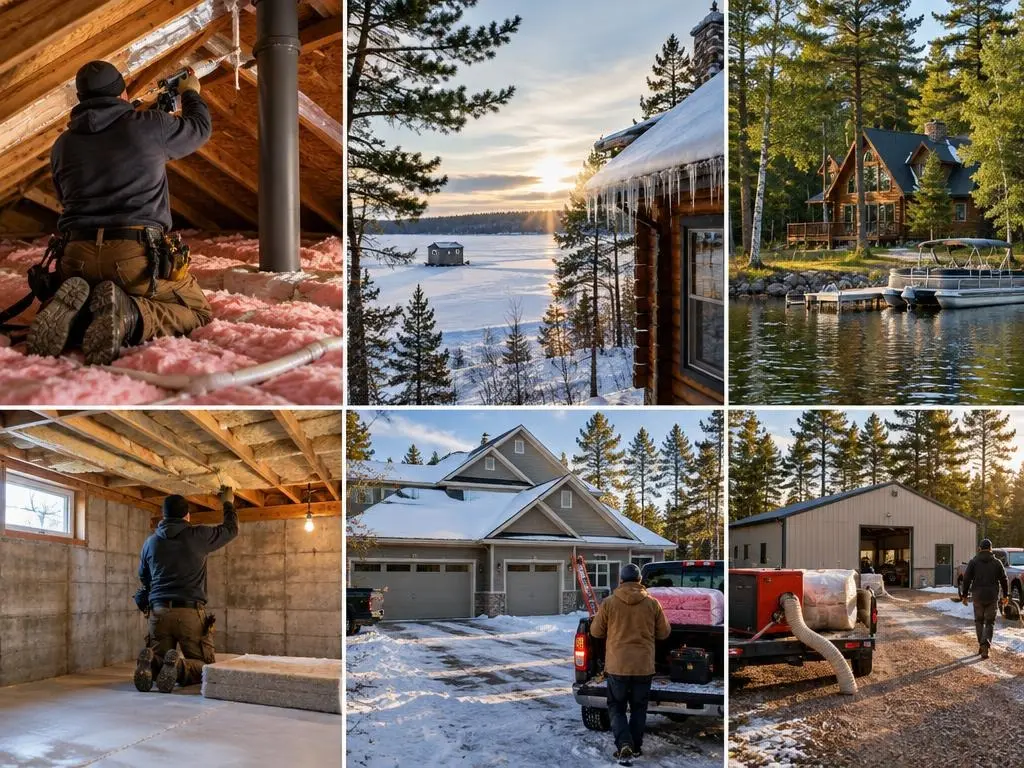
Six types of work, picked part by part for your house or outbuilding, running from closed-cell foam along the rim joist to pulling tired insulation out of an attic.
Spray Foam Insulation
Closed-cell and open-cell foam that insulates and air seals in a single layer, for walls, rim joists, rooflines and whole buildings.
Learn more →Attic Insulation & Air Sealing
Seal the leaks that feed ice dams and attic frost, then bring the attic floor up to Zone 7 depth.
Learn more →Basement & Rim Joist Insulation
Rim joists and foundation walls sprayed with closed-cell foam, so the bottom of the house quits pulling in cold air.
Learn more →Pole Barn & Shop Insulation
Closed-cell foam on steel walls and roofs so shops, garages and pole barns hold heat and stop dripping.
Learn more →Blown-In Insulation
Loose-fill cellulose or fiberglass to bring attic floors up to depth and fill closed wall cavities.
Learn more →Insulation Removal
Clearing out wet, moldy, rodent-damaged or settled insulation so the attic can be sealed and insulated right.
Learn more →Get a Written Insulation Quote for Your Place
We come out, look at the spaces, and give you a written price with the material and R-value for each area.